I was born into Mind Control
Parents:
Mother – Mormon (highest demographic in CIA)
Father – Hollywood child actor, some unspoken trauma; also Navy, like rest of US Military, notorious for experimenting on recruits; see CASU 32, another unspoken trauma
Paternal Grandfather Freemason, 33rd degree
Maternal Grandmother – widowed during Great Depression, then “rescued” and controlled by powerful businessmen when my mother was a child
First home: UC Davis student housing with my parents – Human Ecology Project (CIA Mind Control front) began there when I lived on campus
Left alone in my room for years, taught not to bother my mother (only memories of her are of occasionally talking to the side or back of her head, always feeling neglected), I was given an unending stream of puzzles, crafts, and eventually books, so that I became very focused on projects and highly skilled, but at the loss of fundamental social understanding.
(Coincidentally, these are characteristics of autism, as well as the explicitly stated goals of the creator gods as described in the Sumerian history of humanity on Earth, from which I theorize our CIA is still trying to craft humans to meet those expectations of mental focus and minimal social distractions, and in the process have created this generation of “people on the spectrum.”)
Age 4, I said something (I believe, about not liking what was done to me at night) that made my mother hysterically angry and physically abusive, and she begin her constant habit (all my life ever after) of calling me delusional, which my siblings heard all their lives, which my abusive husbands copied to cover for their abuse, and which my children eventually picked up and naturally believed.
As a mind control subject, I was taught absolute obedience. I also learned to leave my body to avoid pain and abuse, resulting in dissociation and multiple personalities (thankfully not extreme because they were carefully crafted by CIA controllers, and in some cases crafted by myself to be unnoticed by the controllers).
Leaving my body without my controllers, I became familiar with other realms and my helping angels. Talk about this resulted in more accusations of being “crazy,” so I learned to not talk about it, eventually not think about it, and finally forget about it for decades.
Having been taught strict obedience and given little opportunity to exert myself against pressure from others, I was unable to resist the manipulations to join a secret society (a college sorority, through which, I believe, the controllers intended to “handle” me after I left my parents’ control). Even though I felt repelled by and distrustful of them, I was unable to express my contrary decision until I was away from them for the summer – but had already gone through the initiation – too late.
(Incidentally, during the initiation, I went into an altered state and have never remembered the initiation, except for one second when it seems my true self came to consciousness, saw what was in front of me for no more than one second, was horrified, then “left.”)
Before committing to the initiation, we all had been warned that joining then quitting would be “very, very, very, very, very, very, very bad,” yet I could not tell them to their faces that I didn’t like them. I also could not believe they would do anything to hurt us, so I decided to join and then quit when I was gone for the summer, and I did.
I know now that I didn’t understand the nature of the power structures of our world, and that the network of secret societies is absolutely ruthless.
…
I’ve experienced a lifetime of inner arguments I thought were with myself, but which I realize now were actually arguments between myself and my programming.
Please share if you find this information important!
1. A very early childhood nightmare of a cartoon character exposing himself on stage, exposing his girl’s pudendum. I felt horrified and afraid. (Why would a young child create that sort of dream if she hadn’t experienced it herself?)
2. A very early childhood nightmare of my father sitting in the driver’s position on front carriage of an old-fashioned circus carriage train, in a nighttime storm, dressed in black with a tall black hat, whipping a black horse that took us too fast down a bumpy mountain road. Suddenly the train crashed and all the carriages fell over, and I feared the wild animals had gotten out of their cages. I was alone in the dark night, terrified I would be found by a wild animal and ripped apart. (Obviously not sexual, but shows a fear of the night.)
3. When I was 3 or 4, Mom responded hysterically to something I had said, and dragged me into the bathroom, screaming that I should never say anything like that ever again, and knocked a bar of soap around in my mouth, then left me there and went into the kitchen.
I was terrified of her, so waited in the bathroom, but soon my mouth was full of saliva, and I needed to spit it out, but the top of the bathroom sink was at my forehead and I knew I wasn’t allowed to drag a chair in there without permission (and it never occurred to me to spit into the toilet or the tub). Fearful but desperate, I went to the doorway of the kitchen and saw my mother standing there in fury, then tipped my head back to hold in the saliva and asked if I could move a chair. She nodded, and I was able to move the chair to the sink and begin to clean the chunks off of my teeth.
(Obviously not sexual, but I can’t imagine anything other than the possibility of a sexual scandal in the event I would say those words publicly that would make a mother get so hysterical and brutal to her daughter.)
Cropped from photo of me on Mom’s lap
4. A memory of Mom taking me to the doctor and telling him she thought I was crazy because I said “crazy things.” He told her, laughing gently, “No, children just have active imaginations, and sometimes they mix up their dreams with memories.“ But soon she told my aunt, who also laughed and told her no. And I remember when she also told a small group of women who had visited the house and were now in their car getting ready to drive away, and they also laughed and told her no.
All these people telling Mom she was wrong gave me confidence that I didn’t need to take her words to heart.
5. About age 4, I remember being in the den, squatting down and studying the smeared patterns in the linoleum, listening to a man talk to my father, saying, “You marry a Mormon woman, and you get the children too.“ In later reflection, it seemed he was encouraging my father either to engage with me sexually or not feel bad about it if he already was. Much later, I learned that sexual abuse (and mind control) are very common in Mormon families.
6. When I was 8, and we had just moved into our new custom home on in Merced, I heard Dad call my name and came out of the den to find him squatting down to my height, smiling, with Mom standing to the side behind him. I was mesmerized by his smile because I so rarely saw it while making eye contact with me. When I arrived in front of him, he pulled out a steel hypodermic needle from behind his back, held upright, and I stepped back in shock, but he held me there, and I knew not to disobey him. He continued to smile while telling me that it was time for my booster, and he “gave the best shots in town.” He went on to say that I wouldn’t even feel it because he had a special technique. All I had to do was hold my arm really soft and limp, and he patted my arm to help me relax and told me to look away. I followed his instructions and soon he said, “That’s it.“ I was amazed, because I had not felt anything, just like he said.
In preparation for our Christmas party that year, Mom had been calling all the guests, telling them that Stuart Udall (then Secretary of the Interior) would be there. I remember thinking she was bragging, which was something she had told me not to do. At the party, we were supposed to stay in the den and not come out, and I was intent on helping the little ones follow that rule. However, when my littlest siblings tried to sneak out, some woman guest encouraged Mom to let us come out for five minutes, so the little girls burst ahead, winding their way through the crowd, followed by my brother, followed by me.
I was overwhelmed by the crowd of tall people, uncertain whether I really wanted to be there or what to do, so I just followed the other kids and soon saw my doctor talking to my father. The two of them together made me think of shots, so when my doctor had greeted me, and I knew I was supposed to respond with something, I cheerfully said, and loudly over the noise of the crowd,“My daddy gives the best shots in town. He gives me my boosters.“
My doctor looked shocked and immediately swiveled his head around and up toward my father, and I followed, and saw my father look as though he were in deep trouble. There was a third man there also, and the three men all exchanged glances, and the expressions of extreme concern did not go away. Because my doctor was second cousin to Stuart Udall, I assume that the Secretary of the Interior was the third man there.
A few months later, I came home from school to find my mother emptying the kitchen cabinets and packing dishes into boxes. When I asked her why, she answered angrily that we had to move. After we had moved to Paradise Valley, I asked her why we had moved and, while keeping her back to me, she answered that the people in Merced were very snobby and they didn’t want to be a part of that group.
(See 15 below for follow-up.)
7. When I put in my first tampon while squatting over a mirror (as suggested by the instruction sheet), I was shocked to see my inner labia looking very unlike the sketch in the instruction sheet, as mine were long, as if stretched out, and brown, hanging significantly outside the outer labia. I was stunned, but didn’t have the confidence to ever ask anyone about it.
8. Years later, when my sisters and I were swimming naked in the pool and my youngest sister inadvertently exposed herself while hanging on the diving board by her knees, I embarrassed myself by laughing a little hysterically at the sight of her peach-like anatomy, I assume because mine looked so different, but I couldn’t think about it consciously until decades later.
9. When I was date raped the summer of 1970, age 18, I went into an altered state of consciousness in which I could only scream silently in my head, but could not move my body or make any vocalizations.
10. After I was raped, in shock and horrified that I was no longer a virgin (or so I thought), I decided I might as well engage in sex of my own choice, and I wanted to think of it as “my first.” But afterward when I said that to my boyfriend, he repeatedly told me it was OK that I wasn’t and not to keep lying about it.
11. In my mid-30s, having sex with my boyfriend, I suddenly had a flashback in which I was a young child, lying naked on a cotton bedspread with an interesting weave, with a wall to my left, and a few feet away on my right a window with a shade pulled down and bright sunlight coming in thin lines around the edges, and a door in the direction of my feet, and a large blank where I knew a person was standing, looking down at my pudendum.
I felt a sickening dread, but knew I could not leave or stop what was coming, and so I turned my head toward the wall and began a recitation I had previously invented: the wallpaper is gray-green, the flowers are pink with green leaves, in rows that go across and up to the side, and each rose has a frame around it made of white wavy lines, two on each side, and the paint is not laid down evenly, but is thick in some places and thin in others, so the gray-green paper shows through, and I wonder if the workers got in trouble for that.
Then I decided to praise myself, and told myself, “I invented this. No adult taught me.” But that made me almost remember why I had invented this, and I almost came back into my body, so I quickly told myself I had to always stay exactly with the routine and never stop to think about my invention, and I began again at the beginning, “The wallpaper is gray green, the flowers are pink with green leaves….“
Then I was back in my mid-30s body having sex with my partner, extremely shocked by what I had just remembered.
I didn’t know what to call this event, but thought it would be the sort of thing to ask a counselor, but I didn’t want to talk to a counselor about it because I was afraid of what it might mean, afraid that I did not have the time and emotional energy to process it, and also afraid that someone might convince me it meant something that it didn’t mean.
The next day I reviewed my options, again certain I did not have the time or energy or money to deal with this while my children were so young, and I was trying to make a living. So I decided it was important to not think about it, because I might inadvertently change the memory, but I also did not want to forget it. An idea came to me to put the memory into a box and put it on the top shelf of a closet until later when I had time. Oddly, the box I chose was an old-fashioned (50’s?) round, striped hat box.
12. In my late 30s, in the days after the family had gathered for Christmas, a few of us were sitting around the dining table telling stories, while others stood nearby. My brother had just told a story that someone remarked was from a very young age, and I knew I also had a memory from a very young age, so I grabbed a paper napkin and drew while describing the married student housing apartment at UC Davis where my parents lived when I was born:
“The front door was here, and it had a tall, narrow window right next to it with circle-textured glass so you couldn’t see through. The kitchen was right here, and Mom was standing at the stove, and the hood light was on, shining brightly when I looked up. The living room was here to the left, and the linoleum changed to carpet at an angle here. The red leather chair was here.”
At that, my mother said accusingly, “You can’t remember that. You were 14 months old when we left there.“
To which I replied, “But you just acknowledged that I did remember it.“
Mom‘s face was in silent shock, as she pushed away from the table, walked calmly to a window, stood there looking outside, and finally said in a trance-like, singsong voice, “I’ve always said you had an active imagination and you mix up your dreams with memories” - as if she’d said those words a thousand times.
The hair stood up on the back of my neck as I realized she’d said that phrase in those exact same words every time I had ever remembered anything from my childhood, and she’d never said anything similar regarding the other kids.
Mentally scrambling for a reason, I assumed she had done something for which she felt very guilty, and I needed to tell her sometime that my childhood was fine, and she had nothing to feel bad about.
However, driving home from that Christmas visit, I pulled off to the side of the interstate and sobbed over the steering wheel, feeling incredibly sad that my mother had been diminishing me all my life for something she felt guilty about, and my siblings had been hearing these diminishments for their entire lives, and I felt so isolated, so unfairly accused.
Later, I learned this is consistent in families with one abused child.
13. Sometime around age 40, while beginning to cook dinner, I realized I had some memory of someone saying something that I couldn’t understand, but clearly had a distinct cadence that repeated. It came through as a pattern of beats that I had the odd impression had been repeating in my head for at least three days and was associated with a little home in Merced before our custom home.
I told myself I was probably like a “word on the tip of the tongue“ and I’d remember it if I quit focusing on it, so I took down a sauce pan and turned toward the sink to fill it with water, when suddenly those beats turned into someone saying, “You’ve got to stop that soon. She’s getting old enough to remember.“
I had the sickening feeling it was my mother speaking, and whatever it was she didn’t want me to remember was probably not good, probably sexual. I was in so much shock, I couldn’t breathe, and I staggered a few steps to the sink and struggled to hold the pan in my hand because I didn’t want to hear it clatter, but didn’t have the energy in my arms to set it down. I held myself up by my forearms on the front of the sink, and struggled to take in a breath.
14. When I was in therapy, age 41, in 1993, my therapist asked me about my family and what my upbringing had been like, to which I had replied confidently that it was “normal, nothing wrong.” He then asked me to describe some typical interactions with my parents.
To my surprise, I couldn’t think of anything that was nice. All I could remember of my young childhood was of talking to the back or side of my mother’s head,or her being angry at me, or cold and rejecting, like making me stay in my bedroom and not bother her unless it was really, really necessary, and if it was necessary to first figure out how to say what I needed in the fewest words possible, or me sneaking out to sit in the hallway around the corner to listen to her interacting with other people.
The only young memory of interacting with my father was of him being extremely angry at Christmas when he presented me with a wooden child-size stove he had made himself, and I had given it a little attention before being distracted by all the other presents. When I asked about it later, my mother told me he had given it away.
I also remember him taking family photos, and all of us smiling giddily.
I’ve since learned that mothers often emotionally abuse the children who are sexually abused by their father. And calling them liars or delusional is an important tactic to discredit them in the event they ever tell the truth.
15. A few years ago, taking on my mother‘s genealogy work, using ancestors.com, I was prompted to look at “hints” that might be found on their associate site, newspapers.com. I had followed the categories in order, and when I came to “police records,” I expected to find nothing, but clicked anyway, following my habit of orderly progress, and was surprised to see a photograph of my mother, looking very threatened, with narrow window blinds behind her, like those I might have seen in police interrogation rooms on television.
From Police Records, Newspapers.com
I had been efficiently taking screenshots, then clicking for the next item, intending to read everything later, but after I captured her photograph, before I could click on the article, the article and photograph both disappeared.
Because I have documented many events of apparent surveillance on my phone and computer, I assumed someone did not want me to see this and interrupted my access. (I wonder if someone else can.)
I can only guess why her photo was in a police record, wearing her flowered bed jacket and a hairdo like she wore that year in Merced, and wearing such a cornered, silent expression.
…
Today, my siblings have never spoken to me about any of my writing, thoughts, assumptions, or proof, but I’ve learned that they have spoken to my daughter, and possibly my son, about my “mental illness.”
Even though I have openly described myself as a “multiple personality,” I do not consider this a mental illness. When I first realized that I was multiple, I went to the medical library and read everything they had there, and I learned that it should not be considered a disorder or illness. It is simply a creative adaptation to great trauma, and each alternate personality is sane.
But no one in my family wants to discuss this, or hear my opinions on anything. 
I’m 72 now, with a son and daughter who choose not to speak to me any more than necessary, choose not to visit me, even when I tell them I need help, and do not believe I have Lyme Disease or any reason to not to have been cheerful for all of our visits the last decade, or any reason to have skipped some holidays and planned visits.
They seem ready to write me off as “crazy” – just like my mother intended. (And probably just as the mind controllers intended.)
Facing end of life with no strong family connections, but with family ready to discredit my ability to make my own life (and financial and housing) decisions feels like a rather dangerous situation.
And I’m sad, disappointed, scared, and sometimes furious at them for believing what my mother told them all their lives.
Next; Reasons I believe I was a US government mind control subject …
Please share if you find this information important!
I wrote this long time ago, but somehow it ended up in my draft folder….
Is Multiple Personality Disorder (Dissociative Identity Disorder) “crazy”?
Actually, it’s considered a creative solution, usually emerging accidentally in childhood, to keep from going crazy when experiencing something beyond what the psyche can handle, like torture. The vast majority of multiples experienced torture as children in one way or another.
(Today MPD is called Dissociative Identity Disorder, but many of us prefer the old term as more descriptive of our experience.)
How multiple splitting comes about: Under extreme stress, a person, especially a child, might “leave their body” to psychically escape unbearable pain; the mind, however, keeps recording the body’s experience – now on a blank slate – which then becomes another, separate personality.
The initial separation sets a repeatable pattern in the person called dissociation (dissociating mind from body); with ongoing stress, the pattern is repeated again and again, creating more and more alternate personalities, called “alters.” Since some of the alters are too afraid to come back into the body and risk torture again, they remain children. Interestingly, their young psyches may actually help the body stay young-looking – until an older alter comes out.
While the fragmentation of the psyche is not “normal,” each of the fragments, alters, is sane. They each have a sane perspective on their piece of the world. If they escaped pain, they have a psychology that never experienced pain and is normal for that experience. If the alter was one that did experience pain, they may have a neurotic personality, but totally appropriate to and sane for their experience.
Most positive: with all those alters, multiples have potentially more perspective than most – like insects with multiply-faceted eyes. The trick is coordinating the alters, helping the suffering ones heal, giving disruptive alters appropriate new “jobs” and identities, and if communication is a problem, helping everyone communicate, etc.
In ancient societies, multiples were supported and often honored for their diverse perspectives and skills, usually broad, including a range of skills from the mundane to psychic – as the alters who spent the most time dissociated from the body often develop significant psychic skills. These individuals were often trained as shamans.
1976 film Sybil, starring Sally Field and Joanne Woodward
In modern society, on the other hand, there is little recognition, much less appreciation or caring support for multiples. Some find good therapists, but many do not, and the cause of their affliction, the torture, is typically ignored by society. If individuals cannot function well enough to pass as un-fragmented, they live as “disabled” – even though they may have a lot of wisdom with all their perspectives.
Relationships between the alters can be very different from multiple to multiple. Some alters are entirely unknown to the other alters, which causes tremendous problems for the person. Sometimes a person has “co-conscious” alters which work together quite successfully (like myself), though there may be disconnected alters as well that cause occasional problems.
Children under torturous conditions who don’t “leave their bodies” and dissociate often become schizophrenic. So dissociation, MPD, is a blessing in disguise, having saved the child from a far worse possibility. MPD/DID is fairly easy to heal (unless complicated by mind control); schizophrenia, on the other hand, is considered incurable.
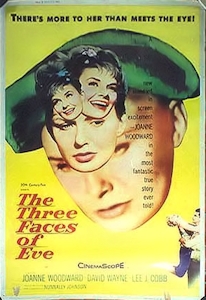
1957 movie starring Joanne Woodward and Lee J Cobb
Being a multiple personality has not been easy, but it’s been far less difficult than typically depicted in books and movies, and in some ways, it seems to be an advantage: Many of us discover we have the capacity to manage a wide variety of mental tasks, having a lot of “minds” holographically in our beings. Managing them all is the trick.
The common perception of “multiples,” as being tragically out of control, is true for some, but many multiples are also very high-functioning, many even testing at genius levels (as I have a few times). Granted, we also often have severe mental, psychological, social, emotional, and spiritual challenges as well – as readers of my book can appreciate.
As for the torture that causes multiple-ness: In the past, torture of children usually happened by accident, a child surviving a wild animal attack, for instance. Unfortunately, their propensity for dissociating was noted by people lacking empathy and any moral code, and they learned to take advantage of them, making literal slaves of the multiples.
In the 1940s, China and the United States, each seeking to protect their wartime secrets from their adversaries, began to experiment on soldiers, splitting their minds through torture – their own citizens, as well as others around the world.
The CIA eventually developed at least 123 mind control programs, the CIA Director testified to the Senate. Researchers have further uncovered evidence that an estimated 20,000 American or Canadian children and many more adults were used between the late 1940s and the mid 1970s – individuals who had no idea they were experimental subjects, did not give their consent, and have never been acknowledged, assisted in healing, or compensated.
The CIA director testified that they destroyed all the files because they wouldn’t do anyone any good. As a consequence, no subject can prove they were involved and disabled in this program.)
Few researchers or subjects believe they destroyed our files. They will never destroy our files, because they have tens or hundreds or thousands of us in some state of useful functionality or dysfunctionality, and no scientist would throw away the product of millions or billions of dollars of research over the decades. No way. So we live with ongoing surveillance, “doctoring,” being used as an amnestic agent and/or being used as an experimental test subject for the newest drugs, technology, and/or programming.
It is clearly criminal, the sort of thing that the United States has apologized for in recent decades, usually a century late. But today everyone is terrified to be the front person for a challenge to this. And even though we have testimony of the highest caliber, the courts refuse to accept our personal testimony that we know we were, and are still, subjects, and most of us have memories breaking through we’re willing to testify about.
The gravity of the crime of mind control is so great that it terrorizes, entrances, silences, subdues our fellow citizens, also useful.
Ironically, it’s a blessing in this situation to be able to dissociate, though the other alters do sense things and can suffer greatly even if they can’t remember why.
Morgellon’s Disease can be painfully isolating – but I’m used to isolation. I’m a mind control subject, and the controllers have always planned for us to be isolated and discredited – in case we’d ever remember what had been done to us.
Since I was a child, my mother has been telling my siblings not to believe me, and while I witnessed her behavior all my life, I’d been programmed to never object to it or anything else my parents might do.
They were being paid, I believe, to cooperate with the controllers with whom they’d contracted when I was a baby, living with them in student housing on the campus of UC Davis where the Human Ecology Project was launched in my first year, a cover for mind control experiments.
My mother created a lot of disharmony between me and my siblings. When they wouldn’t eat all their vegetables, she’d point to me – cruelly mind controlled to obey regardless of my desire – and say, “Why don’t you just eat your dinner like Jean Ann?” and they’d all scowl at me across the table.
Another phase I heard from her often was, “Oh, I’ve always said you had a vivid imagination, and you mixed up your dreams with memory.” Weirdly, she always said the exact same words, never varied, in a sing-song rhythm, so that one day it made the hair stand up on the back of my neck when I realized she seemed to be going into a trance when she repeated the sentence word-for-word, and in that moment I knew something was very, very weird.
I’d just drawn the floor plan of an apartment in which I had my youngest memory, including details about where the linoleum ended and the carpet began and the glazed tall narrow window by the front door – to which she’d exclaimed, “You couldn’t remember that! You were 14 months old when we left there!” Then her face had trembled at the illogic of her words, and she pushed herself up from the table, walked to the window, and said those same words once more.
The memory I’d described rather thoughtlessly (I’d started enthusiastically before realizing it didn’t put her in a very good light but then I had to continue, so I de-emphasized the difficult part) had been of me fussing for her attention, batting around her hips (I was that small), her frustrated response as she stopped her efforts over the stove, threw the spatula, and screamed, “I can’t take this anymore! I’m leaving!” and walked out the door.
My next youngest memory of my mother was of her “washing my mouth out with soap” for something I’d said. I have no idea what it was, but I suspect the thing that enraged her was talking about some sexual abuse in the night. I was so obedient to my mother that after she left me in the bathroom, I followed her, prodding my tongue over chunks of soap stuck to my teeth and my mouth filling with saliva, to get permission to move the step stool so I could spit it all out.
Later, when my baby sister was born, I recall being told to keep my two younger siblings from getting into trouble when my mother took the baby in to nap with her. I was only five and felt burdened to keep two little ones from getting into things they shouldn’t. Of course, they didn’t want to listen to me, and things didn’t always go well. But I still have no memories of my mother’s face or her looking at me.
Today, when I describe anything weird to my siblings, they all ignore me in a similar way; they respond to everything “normal” and are absolutely silent about everything else, even the most extreme.
Once, after I’d woken with a Taser burn on my arm, my face looking as bad as I’ve ever seen it, and my physical energy totally drained for days, I crafted a letter to my siblings and edited it for three days until I thought I had something that was as brief as possible, but still well-documented, limited to what I thought they could handle, with a conclusion simply asking for their advice in addressing this common weirdness in my life, of waking with weird injuries and total exhaustion.
Two of my three siblings responded with one sentence each. My brother would pray for me; my older younger sister said she didn’t have any money to lend (I never mentioned money); and my youngest younger sister just didn’t respond.
Years earlier, I’d learned that all my family had met together without me for a special long weekend at the family cabin, and I was never told the nature of the meeting. I assume they all decided to do something like I’ve heard is done in mental health cases: only respond to what’s “real”; ignore what’s “not real.” I understand. Mom did her job well, and my siblings simply believe I’m somewhat crazy.
That’s not really a problem. I could always just live my life without communicating with my siblings. But one sibling will be executing the family estate one day, and my father’s will has some strange language about money NOT going to anyone who can’t care for him- or herself; and if my brother – who has, as a fundamentalist Christian, chosen to act very hostilely to me in the past, including telling me I’m not in touch with reality as he walked away, waving his hand as if to shoo away any words back from me) – actually believes I’m crazy, then I might get ZERO inheritance – unless I go live in an institution!
So I continue to treat my situation like a good scientist, and document, document, document. I have photos, testimonies, medical records, police records, and more. But my siblings want to hear of nothing; they want to continue to pretend I’m crazy, and no sexual abuse or mind control has had anything to do with our family.
Never mind that our family has connections to Masons, Mormons, the Military, and Hollywood. And one sister hired Madonna’s mother to be nanny to her baby daughter!
One other way I could interpret my siblings’ behavior is that they’re more knowledgeable than they let on, and they know our parents were involved and that I was given into mind control, but it’s best to pretend they don’t know, because it has always been in everyone’s best interests to protect our father (and mother, who passed away last year).
Or maybe it’s to protect themselves. Maybe they’re also in on it somehow. Maybe they became Satanists at some point, willfully or accidentally. Or maybe there’s some other reason.
I choose to believe they were simply encouraged from their earliest years by my mother and father to disbelieve me – because the controllers know that their experiments are not fully refined, and their subjects often “glitch” and realize the weirdness or pain of their lives and want to tell someone. So to head off that possibility, their subjects are called crazy or not dependable from their earliest days to everyone close to them.
The world tells me I have a good mind; I’ve scored high on college exams, Air Force exams (I never joined), and MENSA tests (also never joined). I’ve been offered two six-figure salaries; and in college received comments from three professors that my analyses were the most astute and creative that they’d read in their careers.
Last week, one of my sisters learned about the harsh treatment of migrants in our border jails, and I wrote back to say I wasn’t surprised because of how I’d been treated in jail as an activist. It involved being Tasered and losing 24 hours of memory. She ignored me.
The sad part is my family and exes seems to have also convinced my daughter to distrust me too. My son I’ve chosen not to tell much to, so he’s the only positive “real” connection, but I haven’t had the courage to actually be real, lest he turn away also.
So I live with NO acknowledgement of my reality or the pain or anxiety I suffer, except from random friends now and then who’re dealing with something similar.
I worry about my family. I’d like to protect my kids and granddaughter and some of my nieces and nephews, but the mind controllers have been plotting for decades to keep exactly this from happening.
So I live philosophically. Each of us has their own lessons to learn, and no one can help another learn them. We can support and encourage and love, but ultimately we can’t help.
We have our own spiritual Helpers though, and so I pray for my children and grandchildren, and even my siblings and father and mother on the other side, and my nieces and nephews – that their Helpers are doing what’s possible, and I don’t need to worry. It’s sad, though, never having had siblings to whom I could relate normally.
I’ve enjoyed that sense of family when I’ve connected with the other side. It’s not very often though, at least that I remember.
I don’t blame anyone. We’re all mind controlled to some degree, and some of us with the worst of it can see it better and sooner; those who can’t see it have every reason not to look: it’s scary. I don’t blame them for looking away.
I’m sure life would be delightful if I could pretend this stuff wasn’t real and “make it real,” and I tried that for ten years. But after a decade of denial, throwing all my life energy into other activities, they were always sabotaged and brought down by mysterious forces, either working in me or working through others.
So I accept that my eyes and ears and good mind are right; I’m mind controlled. And those around me have been mind controlled to ignore what I’d like to tell them.
I respect mind control. It’s next to impossible to combat. At least I can’t, yet. So I can’t blame others for turning their backs on me.
Hopefully, we’ll talk about it in the afterlife.
Please share if you find this information important!
Reposted from: http://warisacrime.org/content/defeating-violence-psychiatry By Robert J. Burrowes – Posted on 12 September 2014
As the movement to abolish psychiatry continues to gather momentum – see ‘On Antipsychiatry’ – it is worth reviewing its delusional foundation, the history of its violence and its function as a weapon of elite social control.
Psychiatry is based on a delusional conception of how the human mind works and what is needed in order to assist it to function optimally when it is not doing so. This is because the purpose of psychiatry, with the complicity of other professions in the ‘mental health’ field and the incredibly profitable pharmaceutical industry, as well as the support of the legal system and the corporate media in promoting this violence, has always been about profits and elite social control, not restoring the health of the ailing individual.
The human mind consists of many interacting components. These include sensory capacities (such as sight, hearing and touch), feelings (such as thirst, hunger, nausea and physical pain), memory, ‘truth register’, intuition, conscience, more feelings (such as fear, happiness, emotional pain, joy, anger, satisfaction, sadness and sexual arousal), and intellect.
Each of these capacities is separately important but, in a healthy individual, it is their integrated functioning that is used to crystallize the appropriately precise behavioral option in any given circumstance. If any one of these capacities is not functioning as evolution intended, the individual will suffer accordingly and this might result in a dysfunctional behavioral outcome as well.
Dysfunctional behavior is caused by terrorizing an individual during childhood so that the integrated functioning of their mind is impeded. This occurs when you inflict ‘visible’, ‘invisible’ and ‘utterly invisible’ violence on a child in order to make them do what you want. This violence forces the child to suppress their awareness of the mental processes, especially the feelings, that generated the original and functional behavior so that they can comply with your violence. But their obedience comes at the price of their increased dysfunctionality in the future. For a full explanation of this, see ‘Why Violence?’ and ‘Fearless Psychology and Fearful Psychology: Principles and Practice’.
According to the ‘bible’ of the American Psychiatric Association (APA), the ‘Diagnostic and Statistical Manual of Mental Disorders’ (the DSM), there are roughly 300 officially certified and distinct ‘mental disorders’. But there are no defining physical tests to diagnose any of them. However, given the publication of the DSM is worth over $5 million a year to the APA, historically totalling over $100 million, there is little organisational interest in validity. See ‘Not Diseases, but Categories of Suffering’ .
In fact, as Dr Bonnie Burstow has pointed out: ‘while psychiatry has been claiming for a very long time that people who are “disordered” have chemical imbalances and frequently reiterate that imbalances have been found, the reality is that no imbalances have ever been established for a single “mental illness”. By contrast, the various treatments of psychiatry (e.g., the drugs, electroshock) have been demonstrated to create illness.’ See ‘On Antipsychiatry’.
In short, there is no scientific basis for psychiatry and this is occasionally admitted even by prominent psychiatrists. See, for example, ‘Psychiatry Now Admits It’s Been Wrong in Big Ways – But Can It Change?’ In fact, on 29 April 2013, the highest ranking federal ‘mental health’ official in the USA, Thomas Insel, stated that ‘While DSM has been described as a “Bible” for the field, it is, at best, a dictionary, creating a set of labels and defining each…. The weakness is its lack of validity. Unlike our definitions of ischemic heart disease, lymphoma, or AIDS, the DSM diagnoses are based on a consensus about clusters of clinical symptoms, not any objective laboratory measure.’ And in a candid moment some years earlier, Allen Frances, the lead editor of the fourth edition of the DSM, highlighted the real depth of the problem: ‘there is no definition of a mental disorder. It’s bullshit. I mean, you just can’t define it’. See ‘Inside the Battle to Define Mental Illness’.
But such occasional candid admissions do not lead to change for several reasons: many individual psychiatrists are ignorant of their own ignorance (simply believing, as most people have been terrorised into believing, what they were taught at school and in subsequent training courses) and, of course, institutional forces and profits ensure that such comments are suppressed by the psychiatric, pharmaceutical and media industries ensuring that they do not get through to the public.
Of course, pregnant women and nursing mothers don’t escape psychiatric violence either although groups such as ‘Moms & Meds’campaign to raise awareness of the health and death risks from psychiatric ‘medication’ to the mother and unborn child. And, as you no doubt expect by now, older people, predominantly women, aren’t spared drugging and electroshocking either. Fortunately, in the USA, once a person reaches 65 their electroshocking is paid for by the government which means that, at this age, the number of people diagnosed as requiring electroshocking jumps enormously! See The Necessity of Madness and Unproductivity: Psychiatric Oppression or Human Transformation.
But if you think drugging pregnant women, children and babies is bad, did you know that psychiatrists still electroshock children as well? And ‘electroconvulsive therapy’ is ‘never necessary’, damages the brain, always causes memory loss and sometimes kills! See ‘Electroshocking Children: Why It Should Be Stopped’. Obviously, psychiatrists should not be electroshocking adults either and some organisations actively campaign to end this practice too. See, for example, The Coalition for the Abolition of Electroshock in Texas.
And, of course, psychosurgery, in which ‘a small piece of brain is destroyed or removed’ – ‘irreversible brain mutilation’ as it has been called – is still performed in many countries despite the very long campaign to get it stopped. See, for example, the 1982 article ‘The Return of Lobotomy and Psychosurgery’. ‘In lobotomy and psychosurgery parts of the brain that show no demonstrable disease are nonetheless mutilated or cut out in order to affect the individual’s emotions and personal conduct.’ Despite its horror history, recent ‘justifications’ for ‘irreversible brain mutilation’ are readily found.
The bottom line is this: Most psychiatrists, like most people, are terrified of listening to your feelings (and especially when they are driving dysfunctional behaviour and might need considerable time for healing to occur). This is the inevitable outcome of being terrified of feeling their own feelings. Feelings won’t hurt you; suppressing your awareness of them with drugs, electroshocking or other violence will. Feelings are a vital part of the information your body gives you; feeling these feelings is the way you heal from traumas (great or small) and a vital source of information about what you need to do.
If, like me, you are nauseated by the cowardice and violence of the psychiatrists, doctors, other ‘mental health professionals’ and the pharmaceutical industry personnel who so readily damage our emotional health for the sake of elite social control and personal profit, then you have a simple choice: you can choose to never consult a psychiatrist or other ‘mental health professional’ and you can choose to never subject your child to their violence either. And if you are forced into involuntary psychiatric ‘care’, you can choose to remain silent and pursue avenues for being released.
In the end, even if they forcibly drug you, you have a considerable chance of making a full recovery from this (hopefully short-term) violence. (For expert assistance in withdrawing from psychiatric drugs, check out Gerson Therapy, Psychiatric Drug Withdrawal: A Guide for Prescribers, Therapists, Patients and their Families, Point of Return and the International Coalition for Drug Awareness) Unfortunately, recovery from the brain damage that results from forced electroshocking is far less likely – but for an inspirational account by someone who did survive and fully recover from psychiatric violence, including brain electrocution, you can read Ronald Bassman’s evocative account ‘Never Give Up’ – and recovery from psychosurgery is effectively impossible.
Some people have argued that psychiatry should be reformed. But any experienced nonviolent activist knows that psychiatry, like other manifestations of violence (such as domestic violence, economic exploitation, slavery, ecological destruction and war) cannot be ‘reformed’. We must work for abolition.
Finally, value your emotional health extremely highly. An empathic listener can help you feel your way through those times when you need to feel the sadness, pain, fear, anger and other valuable feelings that evolution gave you to enable a full recovery from the inevitable traumas of life. (Although the information is directed at soldiers who have been traumatised by war, the process as outlined in this article applies to anyone who needs emotional support to recover from difficult life experiences, however ‘trivial’: see ‘An Open Letter to Soldiers with “Mental Health” Issues’.)
If you don’t allow yourself to feel and express the so-called ‘negative’ feelings, you will soon find that your emotional responses to the joys of life will be unconsciously suppressed too.
And life without feelings is not life: it is ‘flatlining’.
***
Biodata: Robert has a lifetime commitment to understanding and ending human violence. He has done extensive research since 1966 in an effort to understand why human beings are violent and has been a nonviolent activist since 1981. He is the author of‘Why Violence?’ His email address is flametree@riseup.net and his website is here.
Please share if you find this information important!




 The CIA eventually developed at least 123 mind control programs, the CIA Director testified to the Senate. Researchers have further uncovered evidence that an estimated 20,000 American or Canadian children and many more adults were used between the late 1940s and the mid 1970s – individuals who had no idea they were experimental subjects, did not give their consent, and have never been acknowledged, assisted in healing, or compensated.


 The Paradigm Salon